The Role of Arabic Language in Science and History
Exploring the language that bridged civilizations, preserved ancient knowledge, and birthed modern science during the Islamic Golden Age.
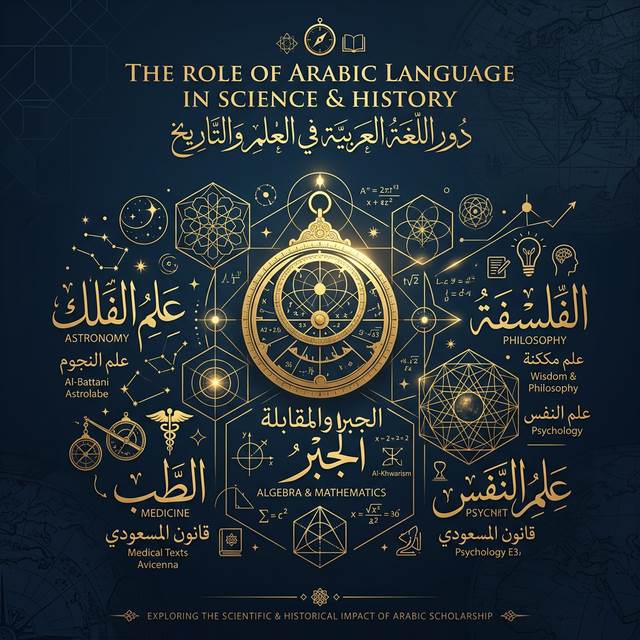
Between the 8th and 13th centuries CE, while much of Europe languished in the Dark Ages, the Arab-Islamic world experienced an unprecedented explosion of scientific, philosophical, and cultural achievement. At the center of this golden era was the Arabic language — the vessel through which ancient Greek wisdom was preserved, transformed, and then donated back to the Western world. Understanding Arabic's role in science and history reveals one of humanity's greatest intellectual stories.
The Islamic Golden Age (750–1258 CE)
The Islamic Golden Age, centered on the Abbasid Caliphate in Baghdad, saw an extraordinary fusion of Arabic language with the scientific traditions of Greece, Persia, India, and Egypt. The Caliph Al-Ma'mun (813–833 CE) established the Bayt al-Hikma (House of Wisdom / بيت الحكمة) in Baghdad — arguably the world's first research university and translation bureau.
Scholars from across the known world were paid lavishly to translate works from Greek, Sanskrit, Syriac, and Persian into Arabic. Works of Aristotle, Plato, Euclid, Hippocrates, and Ptolemy were not only translated but significantly expanded upon by Arab and Muslim scholars.
Arabic Words That Shaped Modern Science
The depth of Arabic influence on modern science is visible in the language itself. Dozens of everyday scientific and mathematical terms are directly derived from Arabic:
| Modern Word | Arabic Origin | Meaning/Field |
|---|---|---|
| Algebra | الجبر (Al-Jabr) | Bone-setting / Mathematics |
| Algorithm | Al-Khwarizmi (الخوارزمي) | Mathematician's name / Computing |
| Alchemy | الكيمياء (Al-Kimiya) | Transformation / Chemistry precursor |
| Alcohol | الكحول (Al-Kuhul) | Fine powder / Chemistry |
| Alkali | القلي (Al-Qali) | Plant ash / Chemistry |
| Zenith | السمت (As-Samt) | Above the head / Astronomy |
| Nadir | نظير (Nadhir) | Opposite / Astronomy |
| Cipher/Zero | صفر (Sifr) | Empty / Mathematics |
| Almanac | المناخ (Al-Manakh) | Climate / Astronomy |
| Elixir | الإكسير (Al-Iksir) | The philosopher's stone / Alchemy |
Key Arabic-Speaking Scientists and Their Contributions
Al-Khwarizmi (780–850 CE) — Father of Algebra
Muhammad ibn Musa al-Khwarizmi was the greatest mathematician of his age. His work "Kitab al-Mukhtasar fi Hisab al-Jabr wal-Muqabala" (The Compendious Book on Calculation by Completion and Balancing) gave us Algebra. His name — latinized as "Algoritmi" — gave us the word "algorithm." He introduced Hindu-Arabic numerals (0-9) to the Western world through his arithmetic texts.
Ibn Sina / Avicenna (980–1037 CE) — Prince of Medicine
Abu Ali al-Husayn ibn Sina's "Al-Qanun fi al-Tibb" (The Canon of Medicine / القانون في الطب) was a 1-million-word medical encyclopedia that remained the primary medical textbook in European universities until the 17th century. It set standards for clinical pharmacology, surgery, and the scientific study of disease.
Al-Biruni (973–1048 CE) — Master of Many Sciences
Al-Biruni calculated the radius of the Earth with remarkable precision using a new mathematical method he devised. He wrote extensively on astronomy, anthropology, geography, and comparative religion. He is considered the father of comparative anthropology.
Ibn Al-Haytham / Alhazen (965–1040 CE) — Father of Optics
His "Kitab al-Manazir" (Book of Optics / كتاب المناظر) transformed the understanding of light and vision, refuted Greek misconceptions, and laid the foundation for the scientific method. He was the first to correctly explain how the eye sees and how lenses work.
Al-Zahrawi / Abulcasis (936–1013 CE) — Father of Surgery
His 30-volume medical encyclopedia "Al-Tasrif" contained detailed illustrations of over 200 surgical instruments he invented — many of which are still used in modified forms today.
Arabic as the Language of Translation and Preservation
Perhaps the most crucial role Arabic played was as a preservation medium. When the Western Roman Empire collapsed in 476 CE, vast amounts of Greek scientific and philosophical knowledge were at risk of being lost forever. Arab and Byzantine scholars systematically translated and preserved these works in Arabic. Without this effort:
- Much of Aristotle's philosophy might have been permanently lost
- Euclid's Elements of Geometry might not have reached the Renaissance mathematicians
- The medical writings of Galen and Hippocrates might have perished
When Europe began its Renaissance in the 14th–15th centuries, much of the ancient Greek knowledge it rediscovered came through Arabic translations — often re-translated into Latin from Arabic rather than from the original Greek.
Stars Named in Arabic
Astronomy was one of the most advanced sciences of the Islamic world. Arab astronomers catalogued thousands of stars and named them. Many of these names persist in scientific use today:
| Star Name | Arabic Origin | Meaning |
|---|---|---|
| Betelgeuse | يد الجوزاء | Arm of the Giant (Orion) |
| Rigel | رجل الجبار | Foot of the Warrior |
| Aldebaran | الدبران | The Follower (of the Pleiades) |
| Altair | الطائر | The Flying Eagle |
| Deneb | ذنب الدجاجة | Tail of the Hen |
| Vega | الواقع | The Plunging (Eagle) |
The House of Wisdom (Bayt al-Hikma)
Founded in Baghdad under Caliph Harun al-Rashid and greatly expanded by Al-Ma'mun, the House of Wisdom was the world's first true research institution. It combined a vast library (reportedly containing millions of books), a translation bureau, an astronomical observatory, and a research center. Scholars of all faiths — Muslim, Christian, Jewish, Zoroastrian — worked together, united by the Arabic language as their common medium of intellectual exchange.
The House of Wisdom was tragically destroyed by the Mongol invasion in 1258 CE when Hulagu Khan sacked Baghdad. Contemporary accounts describe the Tigris River running black from the ink of thousands of books thrown into it.
Legacy: Arabic's Permanent Mark on Western Civilization
The legacy of Arabic scholarship is stamped permanently on Western civilization:
- The numeral system you use every day (0-9) reached Europe through Arabic texts
- Algebra is an Arabic invention that underlies all modern mathematics
- Astronomical data from Arab observatories was used by Copernicus and Galileo
- Medical knowledge from Ibn Sina's Canon was used in European universities for 600 years
- Philosophical translations of Aristotle came to Thomas Aquinas via Averroes' Arabic commentaries
📝 Connect with Arabic's Rich Legacy
Type Arabic text and explore this living language online — free.
Open Arabic KeyboardFrequently Asked Questions
The Islamic Golden Age is generally dated from the 8th century CE (the founding of the Abbasid Caliphate in 750 CE) to the 13th century CE (the Mongol destruction of Baghdad in 1258 CE). Some scholars extend it to the 14th-15th centuries in regions not affected by the Mongol invasion.
Bayt al-Hikma (House of Wisdom) was a major intellectual center in Baghdad, established under the Abbasid Caliphate in the late 8th century. It served as a library, translation bureau, research institute, and university. Scholars of many faiths collaborated there, translating and expanding upon Greek, Indian, and Persian knowledge — all in Arabic.
Through the 11th-13th centuries, as Europeans came into contact with Arab civilization via Spain (Al-Andalus) and the Crusades, Arabic mathematical texts were translated into Latin. Fibonacci's famous "Liber Abaci" (1202 CE), which introduced the Hindu-Arabic numeral system to Europe, was based on his studies with Arab scholars in North Africa.